The most-novel thing arising from System Re-imagining is not the Frequent Network. It's not the fact Northwest Transit Center will boast more routes connecting with it than anywhere else in METRO's service area.
Currently, a good number of local bus routes do not have service on Sundays. In fact, on Sundays, our Frequent Network is reduced from about ten routes (weekdays) to only service running directly on Westheimer to Hillcroft from Downtown, especially between Hillcroft and Chimney Rock (81/82/53). Saturdays is a little bit better with about two or three streets running Frequent Service. But even on Saturdays, there are a good number of routes that have greatly-reduced service or no service at all.
With the Draft Proposed Network Map, all but about four or five routes will run seven days a week with frequency equivalent to weekday/midday! Those routes not running on weekends are odd routes that serve only weekday-rush hour spans of time.
True seven-day-a-week service in mass-transit of any sort... This, I do not believe, has ever been done in the history of our region, and may very well be for many people the single-greatest game-changer with the coming new network of local bus service.
With this and the grid-based paradigm on which the new network will be based, METRO finally abandons the age-old ridership model of going to work in Downtown and going right home again with nothing in-between and with only a little bit of service on weekends for grocery trips. I also see in this a strong attempt by METRO for the first time ever at making local mass-transit much-more appealing to people other than those who cannot afford an automobile.
Upon further thought, though, perhaps the biggest revolution with System Re-imagining is not even seven-day-a-week service, but that the fact the agency is even being allowed to pursue this project in the first place. Again, I say this: please, next Mayor of Houston, for Heaven's sake, please don't appoint a do-nothing METRO Board who will mess this all up!

Jeff Ragsdale's musings on all-things mass-transit in the greater Houston-Galveston area
Thursday, July 31, 2014

Tuesday, July 29, 2014
More thoughts on FLEX
As currently proposed, we stand to have five FLEX zones: 395 N. Shepherd FLEX, 398 Jensen FLEX, 377 Mesa FLEX, 378 Kashmere FLEX, and the 376 FW/DH FLEX.
Overlaid with old routes, here are the proposed Northeast Houston FLEX zones...
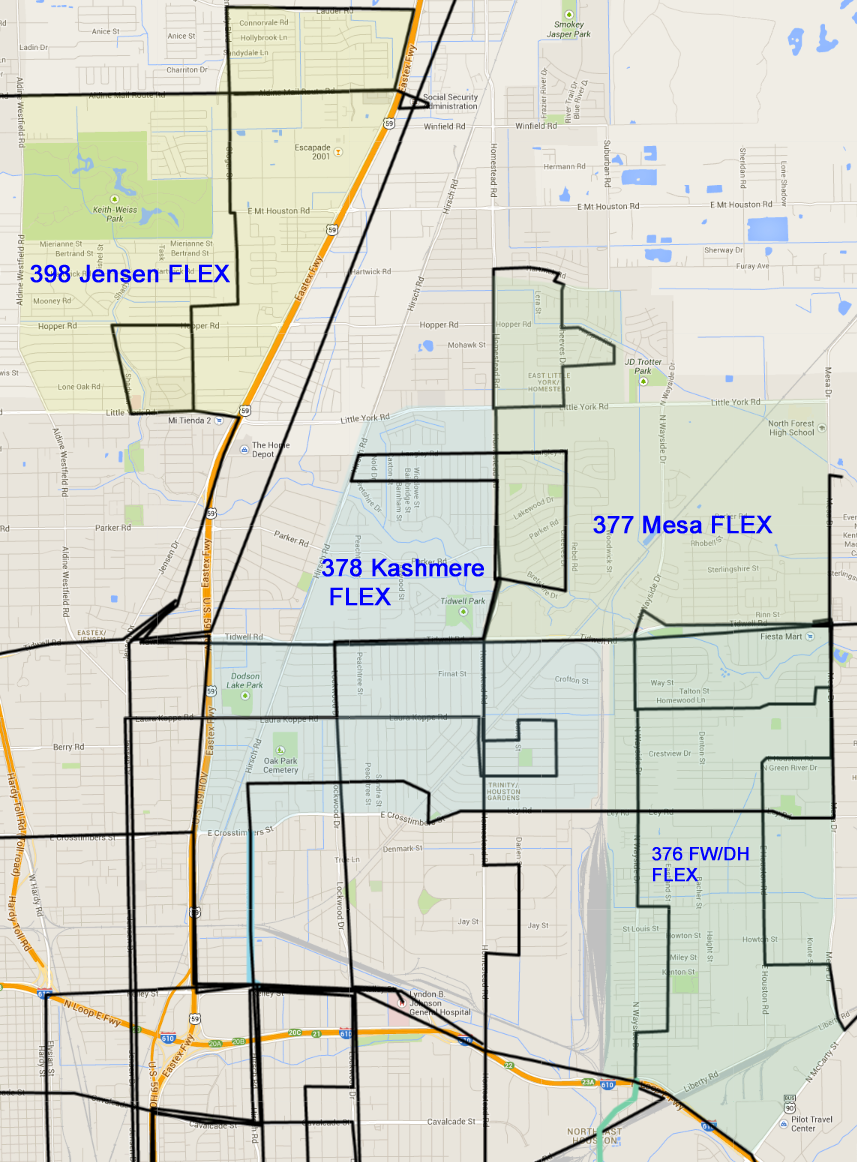
When I call our current network a Salvador Dali - Jackson Pollack nightmare, this is what I'm talking about. Look at all that duplicate service, twisting, and turning for so little return on ridership!
And now, these four zones overlaid with re-imagined routes... Red lines are fifteen-minute-or-better Frequent Network routes. Blue lines are half-hour frequency. Green are one-hour frequency. Note the hourly route from the 376 FW/DH Flex Zone to the Fifth Ward / Denver Harbor Transit Center. Ditto for the 378 to Kashmere TC... The 377 connects at Mesa TC...at least according to the current online .pdf route details whereas the interactive draft map has the dropoff/connection point at Kashmere TC.
And now, these four zones overlaid with re-imagined routes... Red lines are fifteen-minute-or-better Frequent Network routes. Blue lines are half-hour frequency. Green are one-hour frequency. Note the hourly route from the 376 FW/DH Flex Zone to the Fifth Ward / Denver Harbor Transit Center. Ditto for the 378 to Kashmere TC... The 377 connects at Mesa TC...at least according to the current online .pdf route details whereas the interactive draft map has the dropoff/connection point at Kashmere TC.


And here is the 395 N. Shepherd FLEX...


What I do know is this: if I'm living in these areas and if I can be sure I will be reasonably safe walking, and if it's not two-hundred degrees outdoors, I will walk to and from the one-mile-approximate each was to and from the bus. The lack of a great deal of connectivity to the Frequent Network is a real problem. Clearly, this is a system for seniors in that I can walk to and from my fixed routes far faster than the two-hour call-in-advance requirement all the zones will presumably require, a phone call that will effectively begin my trip right then.
One hates conclusions based on partial information, therefore, I am not dismissing FLEX outright. It will be interesting to see how METRO can alleviate the problems caused with the two-hour call-in-advance time requirement as well as how efficient routings and the driving of these routings can be.
FLEX is a brand-new creature to the Bayou City and our region. It will be fascinating to see how it works out, but for the few people affected by these new FLEX zones, right now it seems riding the bus will be a far-more complex venture than ever before.
May I be proven wrong.
Monday, July 28, 2014
FLEX: an introduction and why it could torpedo System Re-imagining
FLEX. as in FLEXible...
It is a concept in mass-transit used in many places for those parts of communities that do not have enough ridership to justify regular fixed routes, but enough ridership to justify at least some coverage. In the METRO service area, these areas of sparse ridership still needing at least some coverage are large swaths of Northeast Houston and parts of North Houston.
The theory is this: bus takes a regular fixed route through a FLEX zone, but according to passenger requests made in advance by phone or other means, deviates from that regular fixed route within the geographical limits of the FLEX zone to pick up and drop off passengers.
Having to phone METRO two hours in advance for a pickup is the bothersome aspect of this, but I'm not sure of any way to shorten this time without unduly vexing our bus operators. How METRO solves this conundrum, if it can, will be interesting to see.
Unfortunately at this writing, METRO has yet to put out a proper presentation as to how its iteration of FLEX zones will work. For an idea of how FLEX works in other places, watch presentations from Tampa and Cape Cod on their FLEX services, which I think will differ from METRO's somewhat.
We stand to get FLEX zones with METRO because the agency opted to be aggressive in resource re-allocation on ridership-numbers focus as opposed to geographical coverage. With this intense ridership emphasis, it stands to reason there will be those who would have their bus coverage reduced, but not eliminated completely. Those people are in the sparsely-populated Northeast Houston and parts of North Houston. These people are getting fewer routes, but they are getting the flexibility of a bus coming near or right to their door to pick them up.
Unfortunately, again, to get that bus pick-up, they have to call METRO at least two hours in-advance. As an African-American friend of mine put it: 'METROLift for able-bodied people'. And we know how well METROLift works sometimes: mostly well, but not always.
A friend of mine used to live where he would catch the current 137 Northshore. And he is feeling for the people in those areas of town near where he once dwelt. To see the full effect of the changes in the coming FLEX zones, look to my rendition of METRO's current network overlaid with the new Draft routes and FLEX zones.
Look at all the miles and miles of routings being done away with in favor of FLEX! This is a consequence of the budget-constrained way in which METRO has to go about the whole project of System Re-imagining: no reduction of local bus resources, but no increase, either. And the offing of these old routings, which had very little ridership, anyway, is part of the reason why the draft Frequent Network stands to be so immense. That many local bus resources were freed to be put elsewhere.
But there may in all this be a perception of 'discrimination' of one sort or another, I think. And it is this perception of discrimination on the basis of geography or income - but not race - that I think METRO Board Member Jim Robinson may latch onto re the FLEX zones. Robinson, more than anyone else on the Board, publicly advocated for making sure no-one had their bus service taken from them entirely.
METRO has a hard sell in store regarding FLEX. To really help make the proposed Frequent Network what it desperately needs to be for the future while remaining within budget, METRO needs to free local bus resources for re-allocation. To this end, METRO needs these FLEX zones, which allow buses to not take their former circuitous ways through sparse-ridership neighborhoods save when they truly need to, thereby saving money spent on gas and repairing wear-and-tear on our vehicles.
FLEX could play into the reservations of Jim Robinson concerning ridership coverage, which, in turn could sway other members of the Board, starting with Siegel and Castañeda, perhaps, and then going on to Ballanfant and Lewter with the other four (Spieler, Garcia, Watson, and Jefferson) digging in their heels while the great part of the imagination and power of the Draft Proposed Map is watered down into something resembling the frequency issues we have with the current network.
I'm probably hyping things way too much in that in all the critical votes on System Re-imagining, there has been unanimity without exception, even from Jim Robinson. There was also unanimity from former Board Member Carrin Patman, and I think former Board Member Jim Stobb, replaced by Jim Robinson in late October 2013, was on-board, too, though I admit this was about the time when I really started paying attention to what our Board was up to and, thanks to System Re-imagining, taking a real interest in what METRO was doing.
But we must respect the fact that people don't always think in pure and logical ways. The current draft proposed transit map - unveiled for public comment on 8 May of this year, is pure and logical and devoid of public input. The Final map on which the Board will vote in September will have probably a good number of changes based on this public input.
But we do not know for sure the Board will vote for this Final Map. Anything could happen, and should 'something' go down, FLEX will have at least something to do with it. Once Board approval comes, we can all rest easy, and so far, the Board in its public appearances at committee and regular full meetings has not been opposed to what's been done so far or spoken out about anything related to System Re-imagining. Again, though, until Board Chair Gilbert Garcia declares a favorable vote for adoption of this final map in September-ish, we cannot rest easy.
Make Jim Robinson at least not too perturbed, and all will be well. And we can be quite sure Christof and Gilbert, for whom System Re-imagining is their magnum opus of the work they have done on the METRO Board these four years on, will make sure everything is done to keep the concerns of our Mr. Robinson at bay.
And I think it will be easy to keep him at bay. While asking the right questions and having certain reservations, he has nevertheless always been enthused with the concept and at least most of the resultants of System Re-imagining, and if FLEX can be dealt with in the right way and sold to the public well, I see no reason why the September-ish 2014 Board Meeting with a unanimous vote of approval of System Re-imagining will not be of the advent of a brilliant new transit network a moment of wondrous celebration laced with more than a little relief and awe at what will be the start of a new era in Houston mass-transit.
It is a concept in mass-transit used in many places for those parts of communities that do not have enough ridership to justify regular fixed routes, but enough ridership to justify at least some coverage. In the METRO service area, these areas of sparse ridership still needing at least some coverage are large swaths of Northeast Houston and parts of North Houston.
The theory is this: bus takes a regular fixed route through a FLEX zone, but according to passenger requests made in advance by phone or other means, deviates from that regular fixed route within the geographical limits of the FLEX zone to pick up and drop off passengers.
Having to phone METRO two hours in advance for a pickup is the bothersome aspect of this, but I'm not sure of any way to shorten this time without unduly vexing our bus operators. How METRO solves this conundrum, if it can, will be interesting to see.
Unfortunately at this writing, METRO has yet to put out a proper presentation as to how its iteration of FLEX zones will work. For an idea of how FLEX works in other places, watch presentations from Tampa and Cape Cod on their FLEX services, which I think will differ from METRO's somewhat.
We stand to get FLEX zones with METRO because the agency opted to be aggressive in resource re-allocation on ridership-numbers focus as opposed to geographical coverage. With this intense ridership emphasis, it stands to reason there will be those who would have their bus coverage reduced, but not eliminated completely. Those people are in the sparsely-populated Northeast Houston and parts of North Houston. These people are getting fewer routes, but they are getting the flexibility of a bus coming near or right to their door to pick them up.
Unfortunately, again, to get that bus pick-up, they have to call METRO at least two hours in-advance. As an African-American friend of mine put it: 'METROLift for able-bodied people'. And we know how well METROLift works sometimes: mostly well, but not always.
A friend of mine used to live where he would catch the current 137 Northshore. And he is feeling for the people in those areas of town near where he once dwelt. To see the full effect of the changes in the coming FLEX zones, look to my rendition of METRO's current network overlaid with the new Draft routes and FLEX zones.
Look at all the miles and miles of routings being done away with in favor of FLEX! This is a consequence of the budget-constrained way in which METRO has to go about the whole project of System Re-imagining: no reduction of local bus resources, but no increase, either. And the offing of these old routings, which had very little ridership, anyway, is part of the reason why the draft Frequent Network stands to be so immense. That many local bus resources were freed to be put elsewhere.
But there may in all this be a perception of 'discrimination' of one sort or another, I think. And it is this perception of discrimination on the basis of geography or income - but not race - that I think METRO Board Member Jim Robinson may latch onto re the FLEX zones. Robinson, more than anyone else on the Board, publicly advocated for making sure no-one had their bus service taken from them entirely.
METRO has a hard sell in store regarding FLEX. To really help make the proposed Frequent Network what it desperately needs to be for the future while remaining within budget, METRO needs to free local bus resources for re-allocation. To this end, METRO needs these FLEX zones, which allow buses to not take their former circuitous ways through sparse-ridership neighborhoods save when they truly need to, thereby saving money spent on gas and repairing wear-and-tear on our vehicles.
FLEX could play into the reservations of Jim Robinson concerning ridership coverage, which, in turn could sway other members of the Board, starting with Siegel and Castañeda, perhaps, and then going on to Ballanfant and Lewter with the other four (Spieler, Garcia, Watson, and Jefferson) digging in their heels while the great part of the imagination and power of the Draft Proposed Map is watered down into something resembling the frequency issues we have with the current network.
I'm probably hyping things way too much in that in all the critical votes on System Re-imagining, there has been unanimity without exception, even from Jim Robinson. There was also unanimity from former Board Member Carrin Patman, and I think former Board Member Jim Stobb, replaced by Jim Robinson in late October 2013, was on-board, too, though I admit this was about the time when I really started paying attention to what our Board was up to and, thanks to System Re-imagining, taking a real interest in what METRO was doing.
But we must respect the fact that people don't always think in pure and logical ways. The current draft proposed transit map - unveiled for public comment on 8 May of this year, is pure and logical and devoid of public input. The Final map on which the Board will vote in September will have probably a good number of changes based on this public input.
But we do not know for sure the Board will vote for this Final Map. Anything could happen, and should 'something' go down, FLEX will have at least something to do with it. Once Board approval comes, we can all rest easy, and so far, the Board in its public appearances at committee and regular full meetings has not been opposed to what's been done so far or spoken out about anything related to System Re-imagining. Again, though, until Board Chair Gilbert Garcia declares a favorable vote for adoption of this final map in September-ish, we cannot rest easy.
Make Jim Robinson at least not too perturbed, and all will be well. And we can be quite sure Christof and Gilbert, for whom System Re-imagining is their magnum opus of the work they have done on the METRO Board these four years on, will make sure everything is done to keep the concerns of our Mr. Robinson at bay.
And I think it will be easy to keep him at bay. While asking the right questions and having certain reservations, he has nevertheless always been enthused with the concept and at least most of the resultants of System Re-imagining, and if FLEX can be dealt with in the right way and sold to the public well, I see no reason why the September-ish 2014 Board Meeting with a unanimous vote of approval of System Re-imagining will not be of the advent of a brilliant new transit network a moment of wondrous celebration laced with more than a little relief and awe at what will be the start of a new era in Houston mass-transit.
Friday, July 25, 2014
My Dream METRO Transit Map...and why it will never exist.
My 'Dream METRO Transit Map' will never exist because I've learned my efforts to make such a thing are - at this point at least - pointless.
More than once, I have taken to Google Maps or some photo-editing program and done up my 'dream' METRO route map - visions of Quicklines and light rail as far as the eye can see and dancing in my head.
As I was not brought on to the community System Re-imagining Stakeholder Task Force until this past 27 February's METRO Board Meeting at which I made what is still my only set of public comments in front of the METRO Board, I came to this dinner party late and far past the previous summer's intense Stakeholder Workshops. I regret not being a part of those, but watching the video archives of these meetings was still a lot of fun.
It is through this Stakeholder process and to a much-larger-and-much-longer extent intensely watching every video and reading every article on this project I can I have come to learn I am no transit planner and that most or all of my dream-maps for METRO would never had worked. Not having the copious amounts of data METRO has at its disposal, in no way could I ever have come up with the level of detail the System Re-imagining planners have put into the Draft Proposed System Map, which will be finalized and sent to the METRO Board for approval later this summer and autumn.
What do I want, then, in a 'dream' transit network? Again, the time was - and not that long ago, I might add - where I would answered that question with an image of a map. Having been enlightened on many things, I've learned to think of these things more conceptually. After much thought, I've realized in the light of history what I want from my transit network is one that does not stay static for years on end.
We need a transit network that grows, expands, contracts and changes with our region. We need transit planners who are allowed to make these changes happen and who are competent enough to make these changes come about with the level of care and detail we see today in System Re-imagining.
And what a foundation for decades upon decades of competent iteration System Re-imagining gives!

Look at that above grid upon which our new network will be based! It's so easy to add and take away and change to the mathematical soundness and geometric efficiency a grid offers, even I could create such a mass-transit network halfway-decently. New streets can easily be added, upgraded to Frequent Service (or downgraded, if need be) with little muss or fuss.
I want a system that puts high-capacity transport modes such as light rail in smart places where there will always be high ridership. Nothing is worse than a billion-dollar project no-one uses. Tumbleweeds and dust bunnies at the new and expensive train station? Horrors!
I want a system that gives people real cause to have pride in their mass-transit in a way Houston has not had since before the first world war. The years 1905-1914 were the great hey-day of mass-transit culture in our town, and I want that culture to make a big comeback and stick around.
I want a system that is allowed to do its thing by future METRO Boards who actually care (like our current Board seems to) about the agency, its mission, and most of all, the people of our region. 2004-2010 Do-Nothing METRO Board? Never again!!
More than once, I have taken to Google Maps or some photo-editing program and done up my 'dream' METRO route map - visions of Quicklines and light rail as far as the eye can see and dancing in my head.
As I was not brought on to the community System Re-imagining Stakeholder Task Force until this past 27 February's METRO Board Meeting at which I made what is still my only set of public comments in front of the METRO Board, I came to this dinner party late and far past the previous summer's intense Stakeholder Workshops. I regret not being a part of those, but watching the video archives of these meetings was still a lot of fun.
It is through this Stakeholder process and to a much-larger-and-much-longer extent intensely watching every video and reading every article on this project I can I have come to learn I am no transit planner and that most or all of my dream-maps for METRO would never had worked. Not having the copious amounts of data METRO has at its disposal, in no way could I ever have come up with the level of detail the System Re-imagining planners have put into the Draft Proposed System Map, which will be finalized and sent to the METRO Board for approval later this summer and autumn.
What do I want, then, in a 'dream' transit network? Again, the time was - and not that long ago, I might add - where I would answered that question with an image of a map. Having been enlightened on many things, I've learned to think of these things more conceptually. After much thought, I've realized in the light of history what I want from my transit network is one that does not stay static for years on end.
We need a transit network that grows, expands, contracts and changes with our region. We need transit planners who are allowed to make these changes happen and who are competent enough to make these changes come about with the level of care and detail we see today in System Re-imagining.
And what a foundation for decades upon decades of competent iteration System Re-imagining gives!
The proposed draft Frequent Network from www.transitsystemreimagining.com
Look at that above grid upon which our new network will be based! It's so easy to add and take away and change to the mathematical soundness and geometric efficiency a grid offers, even I could create such a mass-transit network halfway-decently. New streets can easily be added, upgraded to Frequent Service (or downgraded, if need be) with little muss or fuss.
I want a system that puts high-capacity transport modes such as light rail in smart places where there will always be high ridership. Nothing is worse than a billion-dollar project no-one uses. Tumbleweeds and dust bunnies at the new and expensive train station? Horrors!
I want a system that gives people real cause to have pride in their mass-transit in a way Houston has not had since before the first world war. The years 1905-1914 were the great hey-day of mass-transit culture in our town, and I want that culture to make a big comeback and stick around.
I want a system that is allowed to do its thing by future METRO Boards who actually care (like our current Board seems to) about the agency, its mission, and most of all, the people of our region. 2004-2010 Do-Nothing METRO Board? Never again!!
Wednesday, July 23, 2014
An early tangible harbinger...
During each calendar year, METRO puts out three sets of Service Adjustments for local, Park & Ride, light rail, and anything else METRO does for the general public regarding mass-transit: January, June, and August. June and August are scheduled around the end and start of the school year with 'school-tripper' buses going offline in June and starting up again in August. These 'school-trippers' are not publicly advertised, but are around to help alleviate overcrowding in mornings and afternoons due to scads of kids out and about getting to their classes and home again.
January and August have historically been times with greater numbers of service changes than June (timed for scuttling the school trippers for summer), but 7 June 2015 will mark a bigger June service adjustment than usual: the Mother of All Service Adjustments with the 'switching-on' of the new and re-imagined local bus network in one fell swoop: there will be a last sunset on our current local bus network. The following sunrise will see the new network come online.
Thursday 25 September 2014 will see the regular METRO Board meeting in which the System Re-imagining Final Plan approval will more-than-likely come. From the moment onward when Chairman Gilbert Garcia declares the vote to be (hopefully) in-favor, a massive logistical project begins which I have described in an earlier post: getting the new network implemented.
From 25 September 2014 onward, the Re-imagined network becomes a living, breathing thing. From that Board meeting onward, every Service Adjustment will be directly reflective of the tangible reality of this new network and for a time, the demise of the old.
1 July 2014 saw a remarkable moment that brings out the sentimental part of my nature: the release of the last set of proposed service changes (for implementation in August 2014) with the old network still in full-force and the new network still nothing more than corporeal fog in a somewhat-misty future.
No doubt, January 2015 service changes will reflect the new network in at least some small way.
June 2015 service changes will on the normal pamphlet be written thusly: "o... m... g..."
January and August have historically been times with greater numbers of service changes than June (timed for scuttling the school trippers for summer), but 7 June 2015 will mark a bigger June service adjustment than usual: the Mother of All Service Adjustments with the 'switching-on' of the new and re-imagined local bus network in one fell swoop: there will be a last sunset on our current local bus network. The following sunrise will see the new network come online.
Thursday 25 September 2014 will see the regular METRO Board meeting in which the System Re-imagining Final Plan approval will more-than-likely come. From the moment onward when Chairman Gilbert Garcia declares the vote to be (hopefully) in-favor, a massive logistical project begins which I have described in an earlier post: getting the new network implemented.
From 25 September 2014 onward, the Re-imagined network becomes a living, breathing thing. From that Board meeting onward, every Service Adjustment will be directly reflective of the tangible reality of this new network and for a time, the demise of the old.
1 July 2014 saw a remarkable moment that brings out the sentimental part of my nature: the release of the last set of proposed service changes (for implementation in August 2014) with the old network still in full-force and the new network still nothing more than corporeal fog in a somewhat-misty future.
No doubt, January 2015 service changes will reflect the new network in at least some small way.
June 2015 service changes will on the normal pamphlet be written thusly: "o... m... g..."
Tuesday, July 22, 2014
Acres Homes 44 no more??
If the route-numbering aspect of System Re-imagining holds, then yes, there will be no more METRO local bus route named 44 Acres Homes.
It's times like this I wish I had had a far-better grasp of routing histories throughout the METRO system with the old schedules to go with them. I would be able to give you better background information on the current 44 Acres Homes. However, for our purposes, it suffices to say the current 44 has been around long enough, and Acres Homes has enough pride in its identity to have 'adopted' this route as a part of its culture to the point where this part of town has the nickname, 'The 44'. If METRO gets any slack for its new route-numbering in System Re-imagining, it will be from Acres Homes.
From south to north, re-imagined routes running east-west west of Main and Downtown are numbered 1-29. From west to east, routes running north-south are numbered 30-69. Routes numbered 70-99 run all directions, but they are in an order running from south to north. They include those routes around FM 1960, among them the 94 Acres Homes.
METRO is opting for a logical route structure, but methinks has not quite hit the mark. If it were me, I would have everything west of Downtown running east-west numbered 1-60 with odd numbering. I would have everything east of Downtown running east-west numbered 1-60 with even numbering. Everything running north-south, I would number 61-99 running in an order from east to west.
The few peak only routes as well as the Intercontinental Airport and some other routes, including the 120 FW/DH Northshore Flyer are numbered in the 100s. Park & Ride route numberings are in the Draft Map mostly-unchanged. The 300s are the FLEX Zones, there are no more 400s, and the 700s will continue to be the rail shuttles.
This route re-numbering accomplishes a number of things. It first of all creates a more-intuitive system for the mass of humanity moving into our city. And, it communicates to everyone this is not the old network we all grew up with and that this proposed network is not a continuation of the old local bus network that dates back even all the way to days of the mulecars of the mid-to-late 19thC.
This proposed network of local bus service combined with our other transit offerings is absolutely new.
It is fresh. It is clean. It is modern. It is relevant.
And it does a lot of things differently than our current network does. The current 44 Acres Homes is a very-different thing from the proposed 94 Acres Homes. METRO believes the people of Acres Homes need to know this, and in part, it is the reason for the proposed demise of the old number 44.
However...nothing in this Draft Map is set in stone, including route numbering. METRO is more about ridership than anything else. If the proposed 94 needs to be re-numbered the 44 to get people on the bus, METRO will, kicking and screaming, do that.
And regarding the Final Proposed Map to be presented to the METRO Board this autumn for approval, I will have, yes, a list of predictions of what the Final Map will do compared to the Draft Map. As of this writing, we are about two months removed from that remarkable day when the final network map that will literally transport us forward into the future will to the world at least be revealed.
It's times like this I wish I had had a far-better grasp of routing histories throughout the METRO system with the old schedules to go with them. I would be able to give you better background information on the current 44 Acres Homes. However, for our purposes, it suffices to say the current 44 has been around long enough, and Acres Homes has enough pride in its identity to have 'adopted' this route as a part of its culture to the point where this part of town has the nickname, 'The 44'. If METRO gets any slack for its new route-numbering in System Re-imagining, it will be from Acres Homes.
From south to north, re-imagined routes running east-west west of Main and Downtown are numbered 1-29. From west to east, routes running north-south are numbered 30-69. Routes numbered 70-99 run all directions, but they are in an order running from south to north. They include those routes around FM 1960, among them the 94 Acres Homes.
METRO is opting for a logical route structure, but methinks has not quite hit the mark. If it were me, I would have everything west of Downtown running east-west numbered 1-60 with odd numbering. I would have everything east of Downtown running east-west numbered 1-60 with even numbering. Everything running north-south, I would number 61-99 running in an order from east to west.
The few peak only routes as well as the Intercontinental Airport and some other routes, including the 120 FW/DH Northshore Flyer are numbered in the 100s. Park & Ride route numberings are in the Draft Map mostly-unchanged. The 300s are the FLEX Zones, there are no more 400s, and the 700s will continue to be the rail shuttles.
This route re-numbering accomplishes a number of things. It first of all creates a more-intuitive system for the mass of humanity moving into our city. And, it communicates to everyone this is not the old network we all grew up with and that this proposed network is not a continuation of the old local bus network that dates back even all the way to days of the mulecars of the mid-to-late 19thC.
This proposed network of local bus service combined with our other transit offerings is absolutely new.
It is fresh. It is clean. It is modern. It is relevant.
And it does a lot of things differently than our current network does. The current 44 Acres Homes is a very-different thing from the proposed 94 Acres Homes. METRO believes the people of Acres Homes need to know this, and in part, it is the reason for the proposed demise of the old number 44.
However...nothing in this Draft Map is set in stone, including route numbering. METRO is more about ridership than anything else. If the proposed 94 needs to be re-numbered the 44 to get people on the bus, METRO will, kicking and screaming, do that.
And regarding the Final Proposed Map to be presented to the METRO Board this autumn for approval, I will have, yes, a list of predictions of what the Final Map will do compared to the Draft Map. As of this writing, we are about two months removed from that remarkable day when the final network map that will literally transport us forward into the future will to the world at least be revealed.
Friday, July 18, 2014
A glorious sight
I have been resistant on getting a smartphone. The expense scares me as well as the attractiveness to thieves. However, there are moments when one would have come in very handy.
Thursday 3 July saw me at Christ Church Cathedral (Episcopal) sing along with other adults the final Evensong service of the Royal School of Church Music Gulf Coast Summer Course for Girls. Upon finishing, I walked south to Walker to catch my Westheimer-corridor bus (or buses as it turned out) home.
Along the way, I came across what will become the Central Station transfer points for the East and Southeast Lines. Right then, I wished I had that phone-camera to catch that glorious snapshot. The ultimate wisdom of Lee Brown who pushed through light rail come hell, high water, or Marvin Zindler's restaurant reports has yet to be proven one way or the other, but this much is sure: upper Downtown is changing and is changing fast.
It was brilliant seeing the Capitol and Rusk Central Station transfer canopies just about ready for business - well, about ready for the arduous testing that is to come. Thanks to CAF's delays on getting new rail cars to us and other things going on, perhaps, I've heard through the grapevine the East and Southeast Lines may not go into revenue service until December of this year!
Testing the lines and testing the incoming rail cars will take months and months (can't leave any stone unturned), and integrating all this new stuff with the Red Line will be very interesting. The next eighteen months will be for the entire agency, what with System Re-imagining and the opening of the two new rail lines, as busy and as hectic as any such span of time in its history.
But I am just pleased that things are progressing at all. Whether light rail turns out to be a boondoggle or deus ex...train, doing nothing at all to help alleviate Houston's traffic woes would have been worse if only for the cultural damage to mass-transit doing nothing would have caused.
I cannot tell you how excited all this makes me once more for the re-imagined local bus network to go live next year! By this time in 2015, the sleek, new network will be running along with our trains, and the Harrisburg overpass construction will be under way (we hope), setting the stage for the final portion of the East Line all the way to Magnolia Transit Center.
I am a happy camper and a happy transit rider. And coming across all this Downtown rail progress, it was very tempting to step onto one of the station platforms replete with cones and barricades - perhaps I would be the first private citizen outside of METRO's purview to have done so. I resisted and went on my merry way even happier than I already was in the wake of music and worship at Evensong.
Thursday 3 July saw me at Christ Church Cathedral (Episcopal) sing along with other adults the final Evensong service of the Royal School of Church Music Gulf Coast Summer Course for Girls. Upon finishing, I walked south to Walker to catch my Westheimer-corridor bus (or buses as it turned out) home.
Along the way, I came across what will become the Central Station transfer points for the East and Southeast Lines. Right then, I wished I had that phone-camera to catch that glorious snapshot. The ultimate wisdom of Lee Brown who pushed through light rail come hell, high water, or Marvin Zindler's restaurant reports has yet to be proven one way or the other, but this much is sure: upper Downtown is changing and is changing fast.
It was brilliant seeing the Capitol and Rusk Central Station transfer canopies just about ready for business - well, about ready for the arduous testing that is to come. Thanks to CAF's delays on getting new rail cars to us and other things going on, perhaps, I've heard through the grapevine the East and Southeast Lines may not go into revenue service until December of this year!
Testing the lines and testing the incoming rail cars will take months and months (can't leave any stone unturned), and integrating all this new stuff with the Red Line will be very interesting. The next eighteen months will be for the entire agency, what with System Re-imagining and the opening of the two new rail lines, as busy and as hectic as any such span of time in its history.
But I am just pleased that things are progressing at all. Whether light rail turns out to be a boondoggle or deus ex...train, doing nothing at all to help alleviate Houston's traffic woes would have been worse if only for the cultural damage to mass-transit doing nothing would have caused.
I cannot tell you how excited all this makes me once more for the re-imagined local bus network to go live next year! By this time in 2015, the sleek, new network will be running along with our trains, and the Harrisburg overpass construction will be under way (we hope), setting the stage for the final portion of the East Line all the way to Magnolia Transit Center.
I am a happy camper and a happy transit rider. And coming across all this Downtown rail progress, it was very tempting to step onto one of the station platforms replete with cones and barricades - perhaps I would be the first private citizen outside of METRO's purview to have done so. I resisted and went on my merry way even happier than I already was in the wake of music and worship at Evensong.
Subscribe to:
Posts (Atom)